June 10, 2026
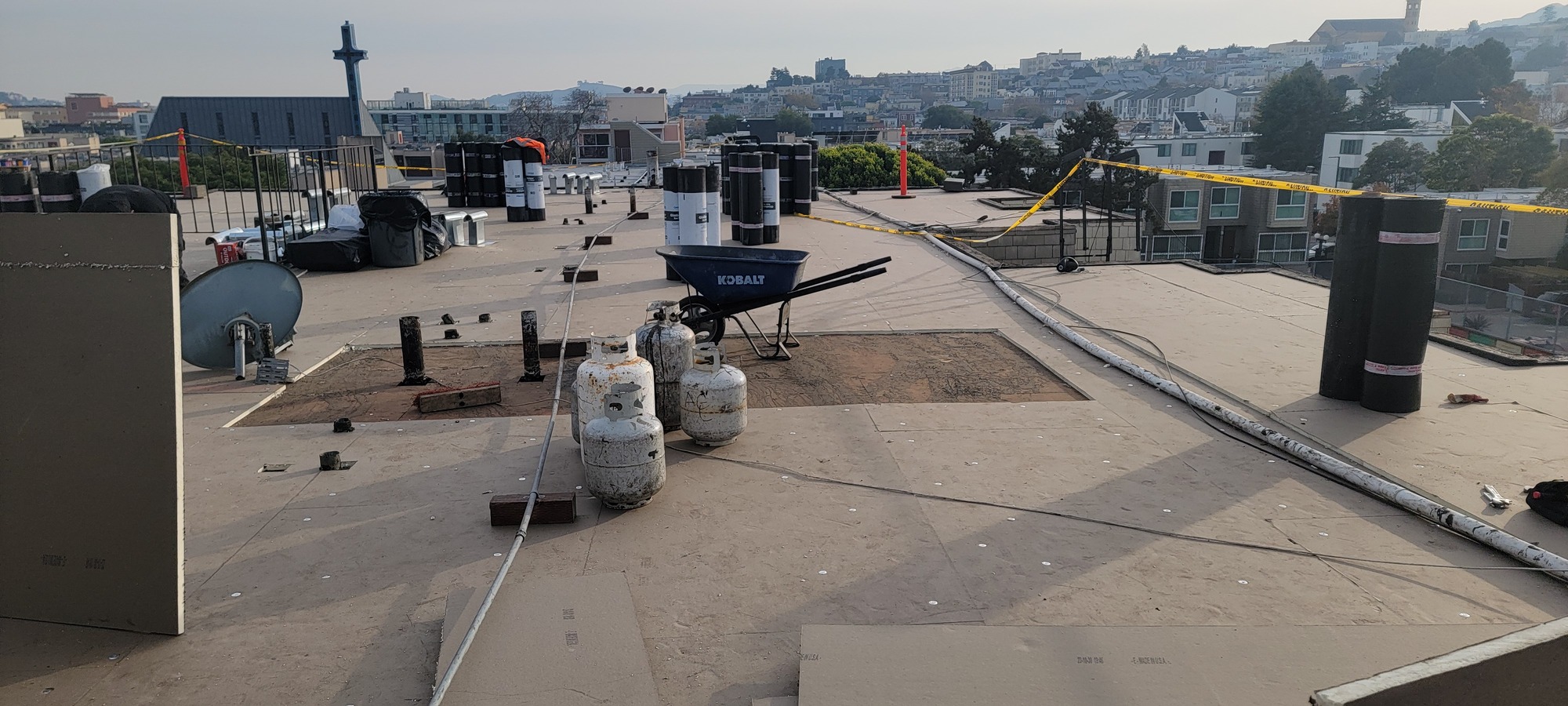
Three flat-roof systems cover almost every low-slope building in San Francisco: TPO single-ply membrane, torch-applied modified bitumen, and self-adhered or mopped modified bitumen. They are not interchangeable, and the right answer depends more on your building and your drainage than on which product a salesperson prefers.
TPO is a thermoplastic single-ply sheet that is hot-air welded at the seams, producing a continuous waterproof field with no adhesives at the joints. It is usually white, which meaningfully reduces heat absorption and thermal cycling — a real advantage on large, sun-exposed SoMa and Potrero Hill roofs and on any building where rooftop equipment or solar makes surface temperature a factor. Expect 20-30 years with maintained drainage. Its weakness is puncture: heavy foot traffic around HVAC units needs walk pads.
Torch-down modified bitumen is an asphalt-based sheet melted into place with an open flame. It is tough, forgiving of irregular substrates, and — critically — highly repairable. A failed seam or blister can be cut out and patched in the field for a few hundred dollars, which is why we frequently recommend repairing a torch-down roof rather than replacing it. Expect 15-25 years. Its downsides are the fire risk during installation (some buildings and insurers restrict torch work) and darker surfaces absorbing more heat.
Self-adhered and cold-applied modified bitumen splits the difference: similar repairability, no open flame, slightly higher material cost and more sensitivity to installation temperature. On occupied buildings, wood-frame Victorians, or anywhere the owner or insurer will not permit torching, this is the system we reach for.
The honest summary: on a large, flat, sun-exposed commercial or mixed-use roof, TPO is usually the better long-run value. On a small-to-medium residential flat field, especially one with irregular geometry and a parapet, modified bitumen is typically the more practical and repairable choice. And on any of them, drainage design decides the outcome — we have replaced 12-year-old membranes that failed purely from ponding, and repaired 28-year-old ones that drained properly the entire time.
Frequently Asked Questions
Which lasts longer, TPO or torch-down?
Well-installed TPO typically lasts 20-30 years and torch-down modified bitumen 15-25 years in San Francisco. Drainage quality affects lifespan more than the material choice does.
Is TPO more expensive than modified bitumen in SF?
TPO usually runs slightly higher per square foot installed, but it reflects heat better and welds into a continuous seam, which reduces long-term repair frequency on large roofs.
Can a torch-down roof be repaired instead of replaced?
Yes — that's its biggest advantage. Failed seams and blisters can be cut out and patched in place, which is why we often recommend repair on a torch-down roof that still has sound insulation underneath.